Clients start welcoming transformation & wellbeing in just a single coaching session!
The Dark Side of Being “Too Self-Aware”
In this blog post, we talk about the dark side of being "too self-aware" or "hyper-aware" and how it differs from a healthy sense of self-awareness.
Priyanka Sawhney
5/2/20263 min read
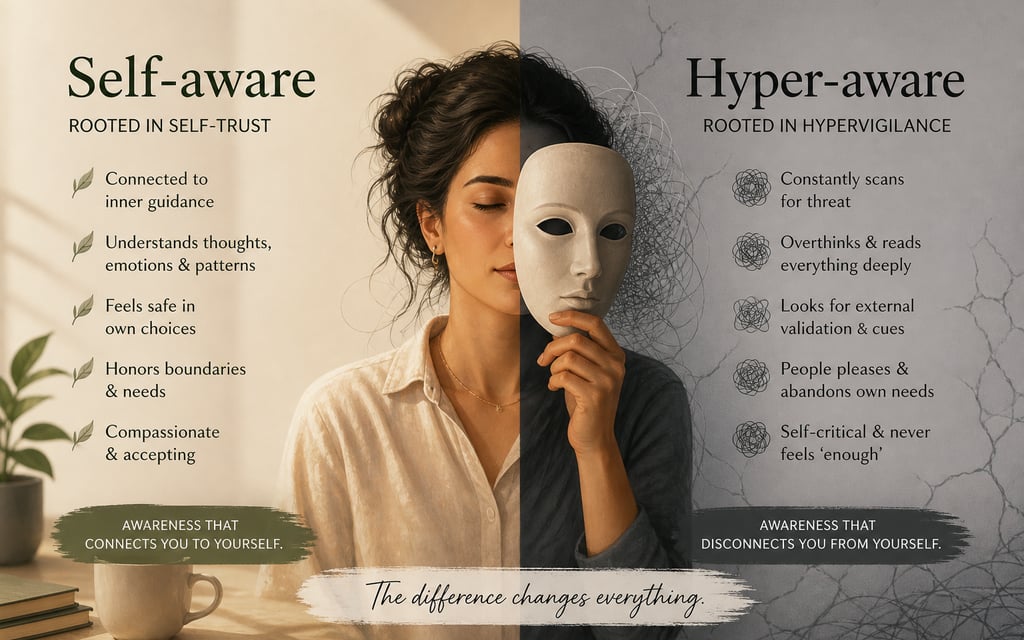
Self-aware or Hyper-aware?
That’s what someone asked during one of our Community Conversations recently.
And honestly, it stayed with me.
People today are becoming increasingly aware of themselves: their thoughts, emotions, behavioural patterns and relationship dynamics. More people are questioning themselves, reflecting deeply and wanting to grow consciously.
And while self-awareness is often seen as a positive quality, I personally feel & have experienced that hyper-awareness can sometimes be a completely different story.
Because not all awareness is rooted in safety, self-trust or emotional wellbeing.
Sometimes, it is rooted in hypervigilance.
Here are a few things I have personally observed beneath the mask of being “hyper-aware”:
1. Hypervigilance & Constantly Scanning for Threat:
When someone becomes overly conscious of what they think, how they sound, how they are perceived or how their behaviour affects others, they may slowly become more attuned to their environment than to themselves.
Their attention moves outward instead of inward.
This can create an external anchor: one that constantly fluctuates depending on people, situations and perceived reactions.
Over time, the person may stop feeling safe in their own choices, emotions or inner guidance because external cues begin to dictate their thoughts, actions and emotional state.
This is where anxiety, overthinking and emotional exhaustion often begin.
Healthy self-awareness feels different.
It does not disconnect us from ourselves. It brings us closer.
Feel the difference?
2. People Pleasing & The Placator Archetype:
This often becomes the natural extension of hypervigilance. Point 1.
In psychology, this is also connected to the “fawn response” - trying to appear more pleasing, agreeable or accommodating in order to feel emotionally safe.
To protect ourselves from the predator (which in today's world equates to perceived threats since no lion is chasing us physically & is about to attack us. But the mind doesn't know the difference, does it?)
In daily life, this may look like:
overextending yourself
constantly prioritising others’ emotions
struggling to express your own needs
avoiding conflict
abandoning your intuition to maintain harmony
What appears as kindness or emotional intelligence & accommodation can sometimes be rooted in fear, self-abandonment and not feeling safe enough to simply be yourself.
The intent is something that deserves attention. Is it a choice made out of love or fear?
Hyper-awareness often replaces intuition with anxiety.
Self-awareness, on the other hand, creates clarity, boundaries and emotional honesty.
One is externally focused & is created to protect the self.
The other is designed to be true to oneself & is an act of feeling secure.
3. Self-Criticism Disguised as Personal Growth:
This one feels especially important.
Recently, I came across a post that genuinely made me pause & think. Here are my final thoughts:
If you are constantly aware of your patterns and endlessly trying to improve yourself, while barely acknowledging your strengths or appreciating what you already do well: is it truly personal growth?
Or is it the underlying belief that you are not good enough?
So much of modern self-development unintentionally reinforces the idea that we are always a problem waiting to be fixed. That we must constantly improve & be better.
But again, as I said, intent matters. The underlying feelings matter.
Are they rooted in lack? Seeking? Self-abandonment?
I personally feel that while growth is beautiful, constant self-correction can become exhausting when it is not balanced with self-acceptance.
This is why I deeply appreciate Louise Hay’s work. At its basis & to the best of my understanding, she focuses a lot on being gentle & kind and not making ourselves wrong. She focuses on personal growth in a way that does not promote chasing/fixing/saving & believing that there is something wrong with us or we are at fault.
Her work frees the spirit. Is food for the anxious heart. Is homecoming in its own beautiful way.
Her teachings on self-acceptance feel like an entire education in themselves - a reminder that healing is not only about changing ourselves or our thoughts, but also about appreciating ourselves for the magnificent beings that we are.
And nothing changes our magnificence.
Accepting ourselves where we are does not stop growth.
On the contrary, it is what finally makes growth feel safe.
And that I feel, is the difference between being self-aware & self-critical, between being self-aware & being hyper-aware.
Food For Thought:
Maybe the goal is not to become endlessly aware of ourselves.
Maybe the goal is to feel safe enough to trust ourselves again.
What do you think - Is it possible that you may be confusing being self-aware with being hyper-aware and sabotaging yourself in the process?
A good affirmation can be: I accept myself as I am and am willing to grow.
(Yes. That one was Louise Hay, with her signature affirmations, love & sparkle dust.)