Clients start welcoming transformation & wellbeing from just a single coaching session!
Why Do I Always Chase Love & End Up With Emotionally Unavailable Partners?
Become aware of the childhood emotional patterns & unmet needs behind current, recurring relationship issues & feeling anxious.
Priyanka Sawhney
5/19/202614 min read
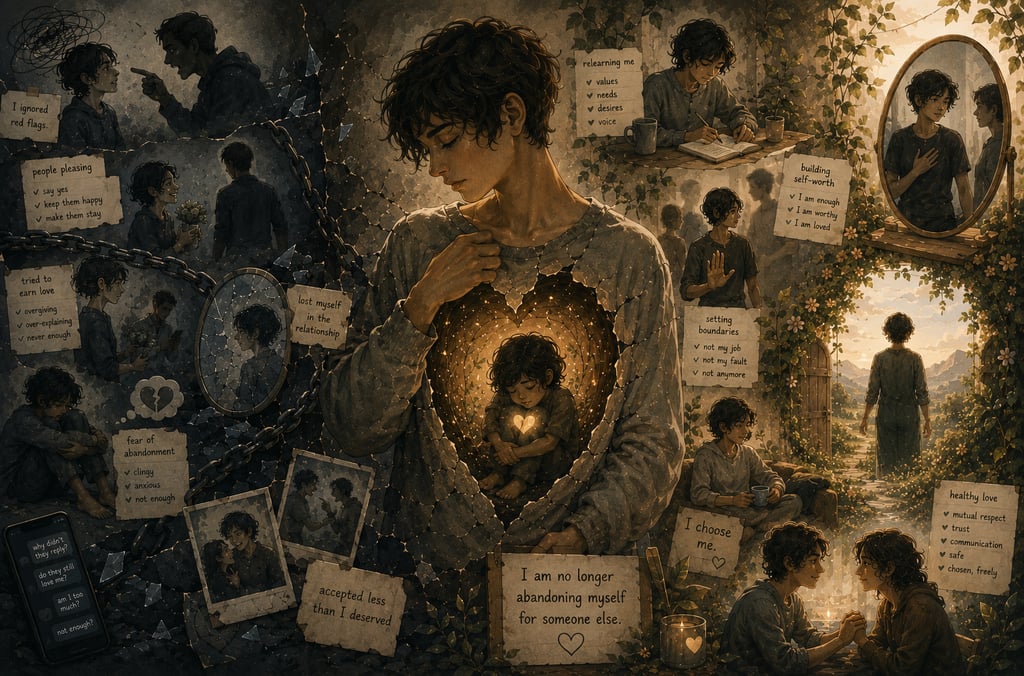

Why Do I Keep Chasing My Partner's Love?
This was the question a young woman in her early thirties asked me during a coaching session.
And honestly, she was not the first one.
Over the years, I’ve met many successful, high-performing women (& some men) in their 20s and 30s struggling with the same thoughts & questions:
“He makes no effort to resolve conflicts. It’s always me.”
“I’m always the one reaching out first.”
“I want my partner to love me more.”
“I keep checking my phone waiting for her. I cannot live without her.”
“Do I go no contact? Will that make them reach out to me?”
“How can I get my partner to give me more attention?”
“How do I get him to commit to me?”
“Why does it always feel like I’m chasing love, affection, and validation?”
And trust me, these people are extraordinary.
Intelligent. Emotionally aware. Independent. Ambitious. High-functioning.
Yet, beneath all of that external success is often one painful longing:
to feel consistently loved, emotionally safe, chosen, valued, and cared for.
Because sometimes, even the strongest people carry deep fears of rejection, abandonment, emotional inconsistency, or not being enough.
I know this because I have lived it too.
For years, I struggled with hypervigilance, panic, over-giving, emotional dependency, and seeking love externally, while appearing successful & “high-functioning” on the outside.
And over the years, both through my own healing journey and through working with clients, I began noticing something important:
This pain is rarely just about the current partner.
Very often, it traces back to one’s earliest experiences of love.
Some grew up with a single parent.
Some had emotionally unavailable or abusive fathers.
Others watched mothers who overworked, over-gave, sacrificed themselves, and spent their lives trying to keep everyone else happy.
And the story can go on.
But this is not about blaming parents.
This is about understanding our earliest lessons about love.
Many of us learnt these lessons not through words, but through emotional experiences:
how we felt treated, ignored, comforted, abandoned, criticised, or emotionally responded to.
And from these early experiences, subconscious beliefs about love were formed.
These beliefs then created survival patterns to help us stay emotionally safe and receive every bit of love we possibly could.
These patterns can show up as over-giving, people-pleasing, emotional shutdown, hyper-independence, emotional chasing, fear of abandonment, perfectionism, or constantly trying to keep the peace.
And over time, these patterns unknowingly begin repeating themselves in adult relationships.
So does relationship anxiety have nothing to do with your current partner?
Well, in many cases, the answer is no.
And even when the answer is yes, when leaving may genuinely be the healthiest choice, you may still wonder why you feel unable to let go.
That is usually where the deeper emotional patterns begin revealing themselves.
Either way, healing begins when we stop running from the discomfort and start gently understanding it.
That is what healing relationships from the inside truly looks like.
The Hidden Beliefs I've Seen Myself & My Clients Carry About Love & Associated Archetypes Displayed:
(These are meant only for awareness of one's thought patterns & how they may show up in situations. All Archetypes & Parallels drawn by me here are for understanding, working on them & not diagnostic purposes.)
1. Love Has To Be Earned, I Am Only As Good As What I Do:
(Can give rise to The Overachiever / Performer Archetype)
This was my belief for so long.
And honestly, over the years, I’ve realised how deeply this pattern shapes the lives, relationships & emotional worlds of so many people I work with.
I started earning when I was 12 & learnt early on that love & affection are not given freely. I cannot emphasise enough how much of my life I spent feeling like a burden to my own family & to almost everyone I had ever met.
My thoughts were something like: Nobody wants to be with me. And why would anyone really want to?
One of my clients complained: He pays attention to that girl who does not even put any effort. And I do so much for him & for every man I have met, yet never get their love or attention.
This thoughts of "doing" & "performing" to earn affection can draw you to people who would need you to earn their love or attention. You know: the ones who show up till the time you're the one putting in all the work & all the effort?
So naturally, without even being consciously aware, one could indulge in cycles of over-giving, proving yourself constantly, proving your love, performing & staying at the best of one's ideal behaviour, all out of the constant fear & lack of love one may feel within.
I have, in the past, overridden myself with so much guilt on not being the daughter who could "do" something for my parents, because without that, I found myself worthless & useless. (Where do = buy them more luxury)
I was also guilty as charged of feeling "I'm no good" after I left Corporate & could not "do" much or "earn" much. That was also, miraculously, the phase when this deep-seated pattern fully exposed itself. :)
Over time, I have noticed how many people silently carry this same emotional burden:
the feeling that they must constantly earn love, attention, reassurance, validation or emotional presence from others. Trust me, I know the exhaustion. :)
This relationship pattern can feed off your illusion of "not being worthy of love unless you do, earn or achieve something" and can make you feel drawn to partners & people who stay a bit aloof, do not reciprocate efforts, take more than they give and always keep you on your toes.
And then comes the resentment of wondering why everyone feels emotionally similar to your parent(s).
This is because the nervous system often recognises & chooses what feels emotionally familiar. You may feel a strange, subconscious attraction towards people who behave just like your parents. And before you know, you subconsciously create the same emotional experience with your partner that you so detest.
And while that realisation can initially feel painful, it can also become deeply empowering.
Because there are two ways to look at these patterns:
one through guilt, blame, victimisation or self-loathing,
and the other through awareness, healing & personal power.
Because if these patterns were learnt, they can also slowly be unlearnt.
You, after all, are the only one in power in your own story.
You can choose differently.
A newer thought pattern could be: I am worthy & valuable for being who I am.
2. Love Means Taking Care Of Everyone:
(Can give rise to The Caretaker / Fixer Archetype)
When attention, validation, or affection are received mainly through being useful to others, love slowly starts feeling transactional.
You begin associating love with: caregiving, emotional labour, fixing, helping, or constantly supporting others, all in hopes that one day they will see it & shower you with love, affection & attention.
And eventually, you may begin feeling more like a parent, therapist, or emotional caretaker in relationships than an equal partner, and have little energy left to invest in your own life.
Somewhere along the way, you stop asking:
“What do I need?”
Because your entire focus becomes:
“How can I make sure everyone else is okay?”
Because once upon a time, being needed or being useful equated to being loved.
Whether it will remain that way going ahead, is well a choice you get to make, NOW. :)
A newer thought pattern could be: I am valuable & loved just as I am. I matter. I take care of my needs.
3. Love Means Managing Other People’s Emotions (& Lives):
(Can give rise to The Therapist Archetype)
I feel I am a blessed child. I can read every person & situation in the room whenever I want.
I am intuitive in the sense that I can easily know what people think & feel, and an ex-self-saboteur in the sense that I was so deeply attuned to other people's emotions & energy.
Because that was my survival.
Growing up without much modelling of emotional stability, regulation or peace, I (& many of the people I work with) never really learnt much about my own emotions, how I felt or how I could regulate myself.
And that made me the smartest & emotionally intelligent person around: the one tuned into everyone else's emotional state, the one who always knew how to comfort the other person, the right words to say, & the perfect best friend. It took me a long while to recognise that this was never reciprocal. I also finally learnt that this attunement was mere survival: so I could feel safe, peaceful & avoid threats or chaos. (I love my smart body, honestly.)
And over the years, I’ve realised how many people silently live this same story.
The one in which you feel responsible for your partner’s moods, reactions, happiness, and healing and spend so much of your time analysing his/her every step & how they feel and ensuring they feel better, because you love them.
All while not being in touch with your own emotions (because you feel they do not matter), not knowing how to soothe the self, & making no space for your emotional self in your relationships.
This can also look like re-reading messages, analysing tones & staying up late at night, emotionally bracing yourself after every disagreement.
This is especially common in families where the caregiver or parent was emotionally volatile, dysregulated & had no space for the child's emotions. The mood, safety & wellbeing of the household depends on one person's outbursts, rage or threat.
And over a period of time, the child may learn that the only emotions that seem to matter are the other person’s.
Because what happens if you stop managing them?
Love may disappear. Safety may disappear.
Validation may be withdrawn.
And for many people, that fear runs far deeper & governs their present much more than they even realise.
A newer thought pattern could be: I am responsible for my emotions. Others are responsible for their emotions. I am safe.
4. Love Means Self-Abandonment & Shrinking:
(Can give rise to The Self-Saboteur Archetype)
You abandon your own needs, boundaries, and wellbeing to “make the relationship work.”
Because that was what your mother did. Or maybe her mother did too. That was the family message.
Or maybe you learnt it watching one of those movies that glorified sacrifice & called it love. That portrayed characters neglecting their own wishes, their own needs & calling their self-sabotage as love. The ones who always said YES & kept their partner's or family's desires above their own, sacrificed their ambitions, their dreams or worse still, did not even know that they could have them.
All they knew was sacrifice, & the immense feeling of guilt about their own needs.
Why? Because they came from families where they were manipulated with guilt.
And this, then becomes a loop where they end up instilling the same guilt in their loved ones saying: Even after all I did for you..
Anytime you choose to break free of this pattern & choose yourself, you may feel guilty. The path to healthier relationships is to do it anyway and the right people will align & support you, the ones who benefitted from your sacrifice will be angry.
And at the end of the day, you will see things (& love) for what they really are.
A newer thought pattern could be: I choose myself without guilt. I love myself.
5. Love Is Inconsistent:
(The key thought pattern behind The Famous Chaser-Runner or Avoidant-Anxious Dynamic)
This pattern can feel incredibly painful.
Especially when emotional inconsistency was normalised early in life.
When love feels unpredictable, even small moments of affection can feel intensely rewarding. It can feel like the first loaf of bread after being starved for so long. It may be a stale loaf of bread and you may still end up glorifying it. :)
This has been me. And I felt so much shame around it. More so in admitting that I was stuck in them.
Even after I knew better. Even when I knew the techniques. Even when I knew the dynamic.
This one becomes really hard to break for so many of us because of the very little & inconsistent love, affection, attention or validation one may have received as a child.
Because of the early, inconsistent experiences around love, achieving someone's love or the perfect relationship can become one's most focused goal in life. Subconsciously. Even when the logical mind knows better. Even when you may never admit it. Even when you may not be fully aware of it.
This dynamic can feel particularly painful as you become addicted to hot-and-cold dynamics, mixed signals, silent treatment and emotional unpredictability. All in the search of that tiny bit of love or proper behaviour. Even when all it gives you & your nervous system is tiny bouts of terror, everyday.
This is especially the case when you have had people abuse, mistreat, take advantage of you in the past & all this behaviour looks slightly better than that. Because "at least he/she does not harm you."
But only if you put in a little more effort in loving yourself, you shall have the love you always dreamed of.
If you're on this path, my heart goes out to you. I cannot remind you enough: that you deserve safe love.
A newer thought pattern could be: I deserve safe & consistent love. I am safe.
6. Love Can Be Taken Away:
(Can give rise to The Hypervigilant Archetype)
You become hypervigilant, anxious, and deeply afraid of abandonment. And slowly, your main goal in relationships becomes protecting yourself: either from becoming “too attached” (which may make you want to run away or shut down emotionally), or from being left (which can make you cling tightly, attach quickly & hold on to people without even fully knowing them or whether they are truly right for you.)
As someone who has lived (& struggled) with panic attacks for 13+ years & worked with numerous people who feel deeply anxious in their relationships, I’ve seen how much it can interfere with one’s sense of discernment & wellbeing.
This fear of loss, of being left again, in the way one may have emotionally experienced in childhood, can make a person feel needy, desperate & emotionally overwhelmed, often confusing chaos, arguments, anxiety, sleepless nights, panic or emotional intensity with deep love.
And as a result, people who are peaceful, consistent, emotionally available & stable may even appear “boring,” while chaos, unpredictability & emotional highs and lows may feel more familiar, attractive or emotionally charged.
Because somewhere along the way, the nervous system learnt:
intense anxiety means intense love.
But where was that first learnt?
Most probably in a chaotic environment where emotional safety, consistency or reassurance did not always feel stable.
But now is not the time for blame, because blame often keeps us emotionally stuck in the same cycle.
Now is the time to slowly come home to yourself, reconnect with your inner child & create the emotional safety within that may have once been missing.
And honestly, that inner work is what has helped me (& numerous people I’ve worked with) feel more emotionally secure, grounded & open to healthier, safer, more loving and consistent relationships.
A newer thought pattern could be: I am there for myself. I love myself. I am always safe.
7. Love Means Endless Patience And Tolerance:
(Can give rise to The Silent Sufferer Archetype)
Love means endless patience, endurance and tolerance. Because people are improving. Because they had a past that made them like that. Because everyone deserves another chance. And isn't endless patience the truest virtue?
This one is so common for women. It is just expected out of them. From sisters, mothers, wives.
I don't fully understand or remember when I learnt this one. Even clients find it difficult to point out to an exact incident or time. Yet, the number of people who believe in "potential of their partners" over their displayed behaviour is on the rise.
Maybe I learnt it from the fact that I always kept waiting for my parents & my friends to show up for me, or to show up better. Maybe because accepting people for who they truly were also meant accepting that they could not give me what I always deeply wanted & deserved: love, acceptance, respect, kindness and emotional safety.
And honestly, that grief can take years to truly process.
Over the years, after releasing a lot of blame & resentment and slowly sitting with the underlying grief, I could finally see more clearly.
How can anyone consistently give me what I seek: love, acceptance, respect, kindness & emotional safety, when I deny those things to myself or believe I am unworthy of receiving them?
And that changed so much for me. And for clients too.
It is now the work of my lifetime to love & accept myself and respect myself enough to keep my own cup full. To bring in discernment & boundaries that protect the sanctity & sanity of my infinite well of kindness & compassion, allowing it to flow more freely, consciously & peacefully.
Because the more we discern, honour ourselves & step away from unhealthy or emotionally draining situations hoping they will someday change, the more freely love flows through our hearts & lives.
And somehow, when that happens, more of that same love flows back too:
through people, experiences, wellbeing, peace & prosperity.
A newer thought pattern could be: I am worthy of safe love that nourishes me. I allow only supportive & loving relationships. I honour myself & my boundaries with ease.
8. Love Means Suffering, Self-Sacrifice & Endurance:
(Can give rise to The Martyr & Victim Archetype)
You pour endlessly into others while neglecting yourself. For you, love means suffering. Suffering must mean that your love is true. Loyalty requires self-sacrifice.
This may look simple but may strengthen the mentality of being a victim, when all of this is self-imposed. And you may end up wondering why life & people are always unfair to you, when you give your 500%.
And deep within, is a small child waiting to be finally recognised, rewarded and appreciated, one that never comes. Or is barely received with an open heart when offered.
By now, do you even know or faintly remember what your own needs are, or that you are allowed to have needs, let alone knowing you are worthy to have them met?
A newer thought pattern could be: I choose to love & nourish myself. I take good care of myself. I am important.
9. Love Means Keeping The Peace & Keeping Everyone Happy:
(May give rise to The Placatory Archetype)
You may be a rebel and defy everyone, never in your wildest dreams see yourself as a people-pleaser yet you may be doing it under stressful conditions.
Let us mark YES/NO to these questions:
Do you avoid conflict?
Do you over-explain your truth?
Do you suppress your truth or true feelings?
Do you find yourself shoving things under the rug pretending they are nothing?
Do you always fear that the other shoe will fall or someone will be upset with you?
Do disagreements make you uncomfortable & you shrink your voice often?
You may call it your personality but it may be a subtle form of self-sabotage that slowly sucks the life out of you?
Ever had a partner who just sucked the life out of you & always blamed you for everything, for creating conflict, bringing things up or for even for voicing your discomfort at their behaviour?
That partner was just a mirror of your own lack of self-trust. And then this lack of self-trust & boundaries creates a vicious cycle of experience after experience, until you completely lose yourself.
And somehow, in the process of being true to these beliefs & to not lose love (that you believe some other person can give you), you just chase love instead of receiving it, freely.
A newer thought pattern could be: It is safe for me to express myself honestly.
10. Love is not safe. Emotions are scary.
(Can give rise to the Avoidant/Withdrawer Archetype)
When emotions are punished or considered a weakness or as bad early on, it becomes easy to disconnect from them and avoid them altogether. This is so common when young boys are taught that emotions are a sign of weakness.
This inability to experience one's own emotions & judgment of the self may later show up as an inability to understand & hold space for the partner's emotions. To provide any real emotional safety in the relationship or manage conflict.
The way ahead?
Communication skills? No. Emotional safety? Yes.
And it begins within. Then goes on to extend in your relationship. :)
A newer thought pattern could be: It is safe for me to feel my emotions. Love is safe.
All these thought patterns & relationship experiences do not mean you are a bad person. (Thanks, Louise Hay.)
These emotional loops may just be a part of you that is still trying to complete an unfinished emotional story from childhood. To finally be seen, chosen, safe & loved.
Your subconscious hopes that this time, through a similar partner, you will finally receive the love you once longed for.
But the loop ends when you begin giving yourself what you were always seeking externally.
The emotional safety.
The reassurance.
The validation.
The consistency.
The love.
Real healing begins when your nervous system no longer associates love with suffering. That is when healthy love starts feeling safe instead of boring.
Peaceful instead of unfamiliar.
Consistent instead of “lacking spark.”
Because the truth is:
You can only fully allow the kind of love that feels emotionally safe and familiar to your nervous system.
This is why self-love is not just a cliché.
It is nervous system healing.
It is subconscious reconditioning.
It is learning that you no longer have to chase, earn, or suffer for love.
You are already worthy of it.
You are worthy of love that is safe, consistent, peaceful, emotionally available, and reciprocal.
If you would like support on this journey, the following resources may benefit you immensely: